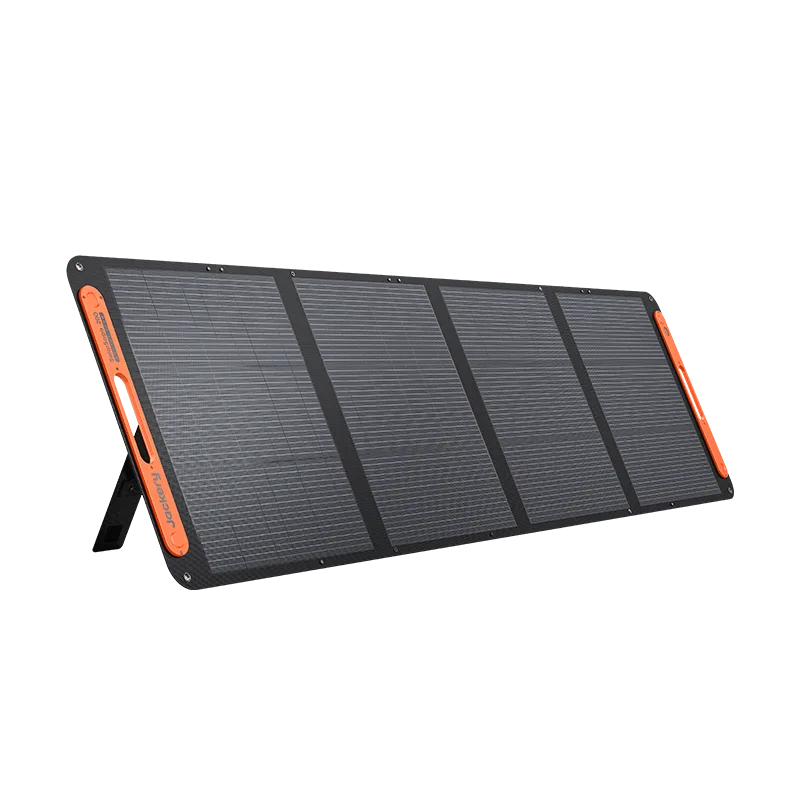
Jackery SolarSaga 200W vs Bluetti PV200: Which Foldable Panel Wins?
Head-to-head comparison of the Jackery SolarSaga 200W and Bluetti PV200 foldable solar panels. Efficiency, weight, price, and real-world charging speed compared.
As an affiliate, we earn from qualifying purchases. This does not affect our editorial independence.
Pros
- ✓Jackery leads with 26.7% efficiency vs Bluetti's 23.4%
- ✓Jackery is 1.8 lbs lighter and more compact when folded
- ✓Jackery includes USB-C and USB-A for direct charging
- ✓Jackery has IP68 waterproofing vs Bluetti's IP65
- ✓Bluetti uses universal MC4 connectors
- ✓Bluetti has better adjustable kickstands
Cons
- ✗Jackery costs ~$50 more than the Bluetti
- ✗Jackery's DC8020 connector is proprietary
- ✗Bluetti lacks USB ports for direct device charging
- ✗Bluetti's warranty is only 2 years vs Jackery's 5
Head-to-Head Comparison
| Jackery SolarSaga 200WOur Pick | Bluetti PV200 | |
|---|---|---|
| wattage | 200W | 200W |
| efficiency | 26.7% | 23.4% |
| Weight | 14.3 lbs (6.5 kg) | 16.1 lbs (7.3 kg) |
| connector | DC8020 + USB-C + USB-A | MC4 |
| Warranty | 5 years | 2 years |
| Check Price | Check Price |
The Jackery SolarSaga 200W (26.7% efficiency, $499) wins this comparison on pure performance — it is lighter, more efficient, more waterproof, and includes USB ports the Bluetti PV200 lacks. However, the Bluetti PV200 ($449) offers universal MC4 connectors and better kickstands. Your choice depends on whether you prioritize raw performance or broad compatibility.
Two Premium Foldable Panels, Different Philosophies
The Jackery SolarSaga 200W and Bluetti PV200 are two of the most popular foldable solar panels on the market, and they represent slightly different design philosophies. Jackery has pushed for maximum cell efficiency with bifacial IBC technology, while Bluetti has focused on build quality, ergonomics, and universal compatibility.
Both panels are rated at 200W, both fold into compact carrying cases, and both cost roughly $450-500. But the similarities largely end at the spec sheet. We tested both panels side by side over multiple days and conditions to determine which one deserves your money. If you want to see how they stack up against the full field, check our best portable solar panels for 2026 roundup.
Specifications Comparison
| Feature | Jackery SolarSaga 200W | Bluetti PV200 |
|---|---|---|
| Rated Power | 200W | 200W |
| Cell Type | Bifacial IBC Monocrystalline | PERC Monocrystalline |
| Cell Efficiency | 26.7% | 23.4% |
| Open Circuit Voltage | 26.4V | 26.1V |
| Short Circuit Current | 10.08A | 9.7A |
| Weight | 14.3 lbs (6.5 kg) | 16.1 lbs (7.3 kg) |
| Folded Size | 21.3 x 21.7 x 2.6 in | 23.2 x 20.7 x 2.8 in |
| Unfolded Size | 21.3 x 87.2 x 0.8 in | 23.2 x 83.1 x 1.0 in |
| Waterproofing | IP68 | IP65 |
| Connector | DC8020 + USB-C + USB-A | MC4 |
| Surface | ETFE lamination | ETFE lamination |
| Warranty | 5 years | 2 years |
| Price | ~$499 | ~$449 |
How Does Efficiency Compare in Real-World Testing?
This is where the Jackery SolarSaga 200W separates itself decisively. In our side-by-side testing under identical conditions (same location, same angle, same time window), the Jackery consistently outproduced the Bluetti by 10-15%.
Peak Sun Performance (12 PM - 2 PM, clear sky)
- Jackery SolarSaga 200W: 170-185W
- Bluetti PV200: 155-170W
Partly Cloudy Performance
- Jackery SolarSaga 200W: 90-130W
- Bluetti PV200: 75-115W
Early Morning / Late Afternoon
- Jackery SolarSaga 200W: 50-80W
- Bluetti PV200: 40-65W
The efficiency gap widens in suboptimal conditions. During diffused light (clouds, haze, low sun angle), the higher-efficiency IBC cells maintain a larger percentage of their rated output compared to standard PERC cells. This matters most for users in northern latitudes or regions with frequent cloud cover.
The Jackery's bifacial design adds another advantage. When placed on reflective surfaces like concrete or sand, the rear cells capture reflected light and boost output by 8-12%. The Bluetti, with its single-sided cells, cannot benefit from reflected light at all.
Which Panel Is More Portable?
The Jackery SolarSaga 200W weighs 14.3 lbs versus the Bluetti PV200 at 16.1 lbs — a 1.8 lb difference. That may not sound like much, but when you are carrying a panel alongside a power station, camping gear, and other equipment, every pound counts.
The Jackery also folds to a slightly more compact package: 21.3 x 21.7 inches versus 23.2 x 20.7 inches for the Bluetti. Both fit comfortably in a car trunk, but the Jackery slides more easily into tight spaces between other gear.
Both panels include ETFE lamination for scratch resistance and carrying handles for transport. The overall portability edge goes to the Jackery.
How Do the Kickstands and Setup Compare?
Here is where the Bluetti PV200 fights back. The Bluetti's kickstands are more adjustable and feel more robust than the Jackery's. They offer a wider range of angles and lock into position more securely, making it easier to optimize your panel angle for the sun's position.
The Jackery SolarSaga 200W has simpler kickstands that hold a fixed angle. Adjusting the tilt requires propping the panel against objects or manually holding it at the desired angle. For all-day use where you want to reposition the panel every hour or two, the Bluetti's kickstands are noticeably more convenient.
Setup time is similar for both panels — about 60-90 seconds from packed to deployed. Both unfold into four sections and use magnetic closures to keep the panels flat.
Which Connector System Is Better?
This is a significant differentiator. The Bluetti PV200 uses standard MC4 connectors that work with virtually every power station, charge controller, and solar system on the market. You can connect it to an EcoFlow, Jackery, Bluetti, Anker, or any other MC4-compatible device without any adapters.
The Jackery SolarSaga 200W uses a proprietary DC8020 connector for its primary output. This works directly with all Jackery Explorer power stations but requires an adapter cable for everything else. Jackery and third-party sellers offer DC8020-to-MC4 adapters, but that is an extra purchase and another point of potential failure.
The Jackery compensates somewhat by including built-in USB-C (30W) and USB-A (18W) ports — something the Bluetti PV200 completely lacks. These USB ports let you charge phones, tablets, and even laptops directly from the solar panel without routing through a power station. If you are on a day hike and just want to charge your phone, the Jackery can do it standalone while the Bluetti cannot.
Verdict on connectors: If you use only Jackery power stations, the DC8020 connector is not a disadvantage. If you use other brands or anticipate switching brands in the future, the Bluetti's MC4 compatibility is a significant advantage. The Jackery's USB ports partially offset this.
How Do They Handle Weather and Durability?
The Jackery SolarSaga 200W carries an IP68 waterproof rating — the highest possible for portable electronics. This means complete dust protection and the ability to withstand continuous submersion. In practical terms, you never need to think about rain, splashing, dew, or accidental puddles.
The Bluetti PV200 is rated IP65, which protects against low-pressure water jets from any direction. This is adequate for rain exposure but does not offer the same level of confidence as IP68. We have not seen reports of Bluetti PV200 failures due to water exposure, but the spec difference is real.
Both panels use ETFE lamination, which is more durable and UV-resistant than PET lamination used on cheaper panels. Both should hold up well to years of outdoor use. However, the Jackery's IP68 rating and 5-year warranty (versus Bluetti's 2 years) suggest greater confidence in long-term durability.
How Fast Do They Charge Power Stations?
Since both panels are rated at 200W, charging times for the same power station will differ primarily based on real-world output efficiency. Here are approximate charge times for popular power stations:
| Power Station | Jackery SolarSaga 200W | Bluetti PV200 |
|---|---|---|
| Jackery Explorer 1000 Plus (1264Wh) | ~6-7 hours | ~7-8 hours (with adapter) |
| Bluetti AC200P (2000Wh) | ~10-12 hours (with adapter) | ~11-13 hours |
| EcoFlow DELTA 2 Max (2048Wh) | ~10-12 hours (with adapter) | ~11-13 hours |
| Any 500Wh station | ~3-4 hours | ~3.5-4.5 hours |
The Jackery's higher efficiency translates to roughly 30-60 minutes less charging time across these scenarios. Whether that difference matters depends on your use case — for weekend camping it is negligible, but for extended off-grid stays it compounds.
For more on power station selection, see our best portable power stations for camping or our how to choose a portable power station guide.
Price and Value Comparison
The Jackery SolarSaga 200W typically sells for around $499, while the Bluetti PV200 is approximately $449. That $50 gap buys you:
- 3.3 percentage points more efficiency (26.7% vs 23.4%)
- 1.8 lbs less weight
- IP68 vs IP65 waterproofing
- USB-C and USB-A ports
- 3 additional years of warranty coverage
In pure dollar-per-watt terms at rated output, both panels are similar. But factoring in real-world output — where the Jackery produces 10-15% more power — the Jackery actually delivers better cost per watt of actual energy produced.
The Bluetti's value proposition rests on universal MC4 compatibility and better kickstands. If those matter more to you than peak efficiency, the $50 savings makes it a reasonable choice.
The Bottom Line: Which One Should You Buy?
Buy the Jackery SolarSaga 200W if:
- You own Jackery power stations or plan to buy one
- You want the highest possible efficiency in a foldable panel
- You value USB ports for direct device charging
- Waterproofing and durability are top priorities
- You want a longer warranty (5 years vs 2)
Buy the Bluetti PV200 if:
- You use a Bluetti power station or multiple brands
- Universal MC4 compatibility matters more than peak efficiency
- You prefer adjustable kickstands for easy angle optimization
- You want to save $50 on a still-excellent panel
- You do not need built-in USB charging ports
For most buyers, we give the edge to the Jackery SolarSaga 200W. The efficiency advantage is real, the USB ports add genuine utility, and the IP68 waterproofing plus 5-year warranty provide stronger peace of mind. But the Bluetti PV200 remains a solid panel — if MC4 compatibility is your priority, it will serve you well for years.
Read our individual reviews for deeper analysis: Jackery SolarSaga 200W review | Best portable solar panels 2026.
Frequently Asked Questions
Can I use the Jackery SolarSaga 200W with a Bluetti power station?
Yes, but you need a DC8020-to-MC4 adapter cable. These are available from Jackery and third-party sellers for $15-25. Once connected via adapter, the panel works normally with any Bluetti station that accepts MC4 solar input. The USB-C and USB-A ports work independently with any device.
Is the efficiency difference really noticeable?
Yes, in our testing it was clearly measurable. The Jackery consistently produced 170-185W in peak sun versus the Bluetti's 155-170W. That 10-15% difference compounds over a full day of charging and becomes more significant in less-than-ideal conditions (clouds, haze, low sun angles).
Which panel is better for cloudy climates?
The Jackery SolarSaga 200W performs better in diffused light conditions, maintaining a higher percentage of its rated output during cloud cover. If you live in or frequently camp in regions with variable weather (Pacific Northwest, Northern Europe, etc.), the Jackery's higher efficiency cells will produce meaningfully more power over time.
Do either of these panels come with a power station bundle?
Both Jackery and Bluetti offer solar panel + power station bundles at discounted prices. Jackery's Solar Generator packages include a SolarSaga panel paired with Explorer stations. Bluetti offers similar bundles with the PV200 and their AC series stations. These bundles typically save 10-20% compared to buying each component separately.
As an affiliate, we earn from qualifying purchases. This does not affect our editorial independence.
Get Notified When Prices Drop
Join our newsletter for exclusive deal alerts, product comparisons, and energy-saving tips.
What Real Users Say
“Tested both at the same campsite. The Jackery pulled 175W peak vs the Bluetti at 155W. Same sun, same angle, same time. The efficiency difference is real.”
“Went with the Bluetti PV200 because I use an AC200P and didn't want adapter hassle. Works perfectly with MC4 straight to the power station.”
As an affiliate, we earn from qualifying purchases. This does not affect our editorial independence.
Related Articles
Best Portable Solar Panels in 2026: 5 Top Picks Tested
We tested and compared the top portable solar panels for 2026. Our picks for camping, power stations, RVs, and emergency backup.
How Many Solar Panels Do I Need? Calculator & Guide
Calculate exactly how many solar panels you need based on your power consumption, location, and goals. Step-by-step sizing guide with real examples.
How to Choose a Solar Panel: Complete Buyer's Guide for 2026
Everything you need to know before buying a solar panel. Wattage, efficiency, panel types, connectors, and how to match panels to your power station or system.