EcoFlow DELTA 2 Max vs Jackery Explorer 1000 Plus: Which One Wins?
EcoFlow DELTA 2 Max vs Jackery Explorer 1000 Plus compared side by side. We test capacity, output, charging speed, portability, and value.
As an affiliate, we earn from qualifying purchases. This does not affect our editorial independence.
Pros
- ✓EcoFlow has 62% more capacity (2048Wh vs 1264Wh)
- ✓Both use long-lasting LiFePO4 batteries
- ✓EcoFlow charges to 80% in just 68 minutes
- ✓Jackery offers 800W solar input vs EcoFlow's 500W
- ✓Jackery is 19 lbs lighter and more portable
Cons
- ✗EcoFlow costs $400 more at $1,699
- ✗Jackery has lower inverter output (2000W vs 2400W)
- ✗EcoFlow is too heavy for easy one-person carrying
- ✗Neither includes a solar panel in the base price
Head-to-Head Comparison
| EcoFlow DELTA 2 MaxOur Pick | Jackery Explorer 1000 Plus | |
|---|---|---|
| Capacity | 2048Wh | 1264Wh |
| Output | 2400W (4800W surge) | 2000W (4000W surge) |
| Weight | 50.7 lbs | 31.5 lbs |
| Battery | LiFePO4 | LiFePO4 |
| Charging | 0-80% in 68 min | 0-80% in ~90 min |
| Solar Input | 500W | 800W |
| Price | ~$1,699 | ~$1,299 |
| Check Price | Check Price |
The EcoFlow DELTA 2 Max (2048Wh, $1,699) and Jackery Explorer 1000 Plus (1264Wh, $1,299) are two of the most popular LiFePO4 power stations. EcoFlow wins on capacity and charging speed; Jackery excels in portability and solar input. Your choice depends on whether you prioritize power or portability.
Two of the Best, But Very Different
The EcoFlow DELTA 2 Max and Jackery Explorer 1000 Plus are two of the most popular portable power stations on the market, and for good reason. Both use LiFePO4 battery chemistry, both deliver serious AC output, and both come from brands with strong track records.
But they are not interchangeable. The DELTA 2 Max is a larger, more powerful unit built for maximum capability. The Explorer 1000 Plus is a lighter, more portable option optimized for ease of use and solar charging. Choosing between them comes down to what you prioritize.
We have tested both units extensively (see our full EcoFlow DELTA 2 Max review and Jackery Explorer 1000 Plus review for individual deep dives). Here is a detailed breakdown to help you decide.
Specs Comparison Table
| Feature | EcoFlow DELTA 2 Max | Jackery Explorer 1000 Plus |
|---|---|---|
| Capacity | 2048Wh | 1264Wh |
| AC Output | 2400W (4800W surge) | 2000W (4000W surge) |
| Boosted Output | Up to 3100W (X-Boost) | N/A |
| Battery Type | LiFePO4 | LiFePO4 |
| Cycle Life | 3000+ cycles to 80% | 4000 cycles to 70% |
| Weight | 50.7 lbs (23 kg) | 31.5 lbs (14.3 kg) |
| Dimensions | 19.6 x 9.6 x 12.4 in | 14.8 x 10.3 x 11.4 in |
| AC Charging | 0-100% in ~96 min | 0-100% in ~100 min |
| Solar Input | 500W max | 800W max |
| USB-C Ports | 2x 100W | 1x 100W |
| AC Outlets | 6 | 3 |
| Expandable | Up to 6144Wh | Up to 2528Wh |
| Built-in Light | No | Yes |
| Warranty | 5 years | 5 years |
| Price (approx.) | $1,699 | $1,299 |
Which Has Better Capacity and Runtime?
Per EcoFlow's official specs and Jackery's product page, the DELTA 2 Max wins this category decisively with 2048Wh versus the Jackery's 1264Wh. That is 62% more stored energy, which translates directly to longer runtimes:
| Device | DELTA 2 Max Runtime | Explorer 1000 Plus Runtime |
|---|---|---|
| Mini fridge (60W) | ~29 hours | ~18 hours |
| CPAP machine (40W) | ~43 hours | ~27 hours |
| Laptop (60W) | ~28 hours | ~17 hours |
| 55" TV (120W) | ~14 hours | ~9 hours |
Both units are expandable, but the DELTA 2 Max goes further, up to 6144Wh with two extra battery packs versus the Jackery's maximum of 2528Wh with one add-on pack. If you are building toward a home backup system, the EcoFlow offers a much higher ceiling.
Winner: EcoFlow DELTA 2 Max: significantly more capacity out of the box and greater expandability.
Output Power
The DELTA 2 Max delivers 2400W continuous with 4800W surge, compared to the Explorer 1000 Plus at 2000W continuous with 4000W surge. Both handle most standard household appliances without issue.
The real differentiator is EcoFlow's X-Boost technology, which lets the DELTA 2 Max run devices pulling up to 3100W by intelligently adjusting voltage. We successfully ran a 2700W space heater on the EcoFlow, something the Jackery simply cannot do. If you need to power high-draw appliances like large space heaters, hair dryers above 2000W, or certain power tools, the DELTA 2 Max is your only option here.
The EcoFlow also offers more output ports: six AC outlets versus three, and two 100W USB-C ports versus one. For charging multiple devices simultaneously, the DELTA 2 Max gives you more flexibility.
Winner: EcoFlow DELTA 2 Max: more watts, X-Boost capability, and more ports.
Which Charges Faster?
This category is closer than you might expect. The DELTA 2 Max charges from 0-80% in 68 minutes via AC (full charge in ~96 minutes), while the Explorer 1000 Plus reaches full charge in about 100 minutes. Considering the EcoFlow has 62% more capacity, its charge rate is proportionally much faster.
Solar charging flips the script. The Jackery accepts up to 800W of solar input versus the EcoFlow's 500W. In practice, with matched panels, the Jackery can charge faster from solar, especially relevant if you are off-grid and relying on the sun as your primary power source. With two 200W Jackery SolarSaga panels, we consistently pulled 350-380W. With two EcoFlow 220W panels on the DELTA 2 Max, we saw 380-420W.
On a watts-in-per-Wh-of-capacity basis, the Jackery is more efficient at solar replenishment.
Winner: Tie. EcoFlow dominates AC charging; Jackery has the edge for solar.
Portability
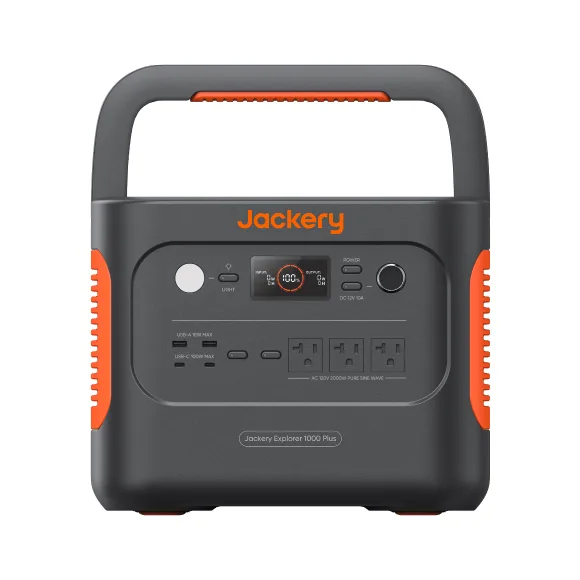
This is the Jackery's strongest advantage. At 31.5 lbs, the Explorer 1000 Plus weighs nearly 20 lbs less than the DELTA 2 Max's 50.7 lbs. It is also meaningfully more compact at 14.8 x 10.3 x 11.4 inches versus 19.6 x 9.6 x 12.4 inches.
The difference is not subtle in practice. The Jackery is a one-hand carry. The EcoFlow requires two hands and some effort. If you are loading and unloading your power station regularly, moving between your car, campsite, and home, the Jackery's weight advantage is significant.
The Jackery also includes a built-in LED light with SOS mode, a small but practical feature for camping and emergencies.
Winner: Jackery Explorer 1000 Plus: almost 20 lbs lighter and more compact.
App and Smart Features
EcoFlow's app is the best in the portable power station industry. It provides granular controls for charge speed, AC frequency (50Hz/60Hz), X-Boost toggles, firmware updates, and historical energy monitoring. It connects via both Bluetooth and Wi-Fi and is consistently responsive.
Jackery's app handles the basics (battery level, input/output wattage, remote on/off) but lacks the depth. You cannot adjust charge rates, there is no energy history, and the feature set overall is thinner.
For users who want a set-it-and-forget-it experience, the Jackery app is perfectly adequate. For anyone who likes fine-tuning their setup, EcoFlow's software is in a different league.
Winner: EcoFlow DELTA 2 Max: significantly more capable app.
Build Quality and Design
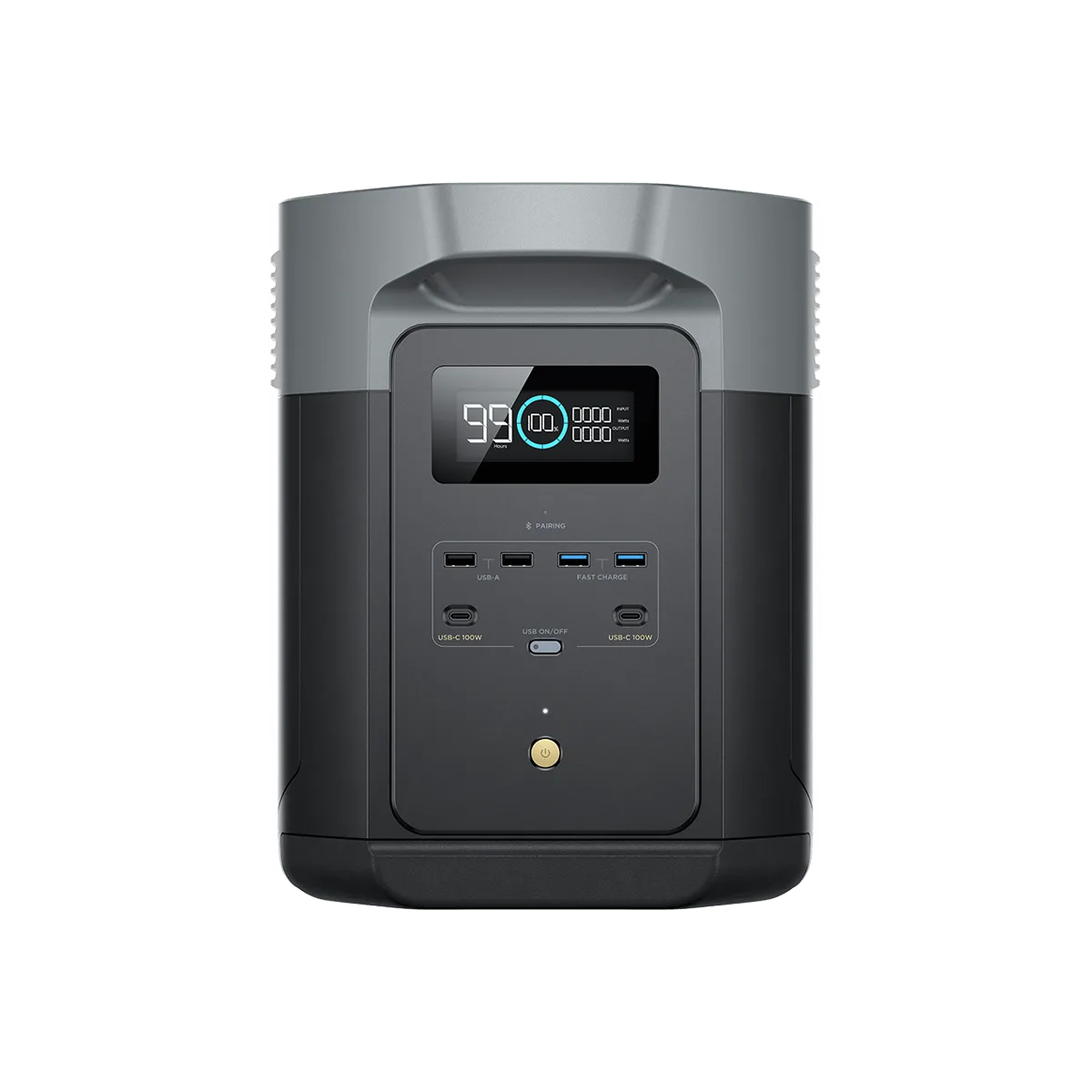
Both units are well-constructed. The EcoFlow has a professional, dark-gray aesthetic with a clear LCD display and logical port layout. The Jackery uses its signature orange-and-black design that stands out visually and is easy to locate in a cluttered campsite.
Build quality is comparable. Both have sturdy plastic shells that handle everyday bumps and travel. Both have clear, readable displays showing essential information.
Winner: Tie. Both are solidly built with distinct design philosophies.
Price and Value
The EcoFlow DELTA 2 Max typically retails around $1,699, while the Jackery Explorer 1000 Plus comes in at approximately $1,299. That is a $400 difference.
On a cost-per-Wh basis, the EcoFlow is actually competitive: $0.83 per Wh versus $1.03 per Wh for the Jackery. You are getting more capacity per dollar with the EcoFlow. However, the total price is higher, and not everyone needs 2048Wh.
If you need the capacity and power, the DELTA 2 Max offers better value per watt-hour. If 1264Wh meets your needs and you would rather save $400, the Jackery is the smarter buy.
Winner: Depends on your needs. EcoFlow is better per-Wh value; Jackery has the lower entry price.
The Bottom Line: Which Should You Buy?
Choose the EcoFlow DELTA 2 Max if you:
- Need maximum capacity and output power
- Want to power heavy appliances (2000W+) with X-Boost
- Value fast AC charging speed
- Plan to expand your system toward home backup
- Want the most feature-rich app experience
Choose the Jackery Explorer 1000 Plus if you:
- Prioritize portability and lighter weight
- Rely heavily on solar charging
- Want a simpler, more straightforward experience
- Have moderate power needs (under 2000W)
- Want to spend less upfront
Both are excellent power stations from reputable brands. The DELTA 2 Max is the more capable machine on paper. The Explorer 1000 Plus is the more practical choice for people who move their power station often and do not need the extra headroom. Neither will disappoint you. For more options, check our best portable power stations for camping 2026 roundup, or read our complete buyer's guide to understand exactly what specs matter most for your use case.
Frequently Asked Questions
Which is better for camping, the EcoFlow DELTA 2 Max or Jackery Explorer 1000 Plus?
It depends on your camping style. For car camping and basecamp setups where you want maximum power and do not move the unit often, the DELTA 2 Max's 2048Wh capacity and 2400W output are hard to beat. For hikers, solo campers, and anyone who moves their station frequently, the Jackery's 31.5 lb weight and compact size make it the better camping companion.
Can I use the same solar panels with both units?
Yes. Both units use standard MC4/Anderson solar connectors and accept input in the 11-60V range. Any compatible third-party panel works with either unit. However, each brand's own panels are optimized for their respective MPPT controllers for the best efficiency.
Which has better long-term value?
The EcoFlow DELTA 2 Max offers better cost-per-watt-hour at $0.83/Wh versus the Jackery's $1.03/Wh. However, the Jackery's 4000-cycle battery rating exceeds the EcoFlow's 3000+ cycles. In terms of total energy delivered over the battery's lifetime, both units offer comparable long-term value. The Jackery delivers more cycles while the EcoFlow delivers more energy per cycle.
Do both units support pass-through charging?
Yes. Both the DELTA 2 Max and Explorer 1000 Plus support simultaneous charging and discharging (pass-through). This lets either unit function as a basic UPS when plugged into a wall outlet. Neither is designed as a dedicated UPS, so expect a brief switchover delay during power transitions.
Which unit is quieter?
Under light loads, both units are nearly silent. Under heavy loads and during fast AC charging, both produce noticeable fan noise. The DELTA 2 Max tends to be slightly louder during fast charging due to its higher power throughput, but EcoFlow's app lets you limit charge speed to reduce noise, a feature the Jackery app does not offer.
Last updated: March 4, 2026
As an affiliate, we earn from qualifying purchases. This does not affect our editorial independence.
Get Notified When Prices Drop
Join our newsletter for exclusive deal alerts, product comparisons, and energy-saving tips.
What Real Users Say
“Had both side by side for a week. The EcoFlow just powers more stuff, but the Jackery is so much easier to carry around.”
“Went with the Jackery for solar camping — 800W input is unbeatable.”
As an affiliate, we earn from qualifying purchases. This does not affect our editorial independence.
Related Articles
Best Power Stations for Home Backup in 2026: 5 Units That Keep the Lights On
The 5 best portable power stations for home backup in 2026. From whole-home coverage to budget options, find the right backup power for outages.
How Big a Power Station Do I Need? A Step-by-Step Sizing Guide
Calculate the right portable power station size for your needs. Wattage tables, sizing formulas, and product recommendations for every use case.
Best Portable Power Stations for Camping in 2026: 5 Top Picks Tested
We tested dozens of portable power stations to find the 5 best for camping in 2026. Picks for every budget, from car camping to off-grid adventures.